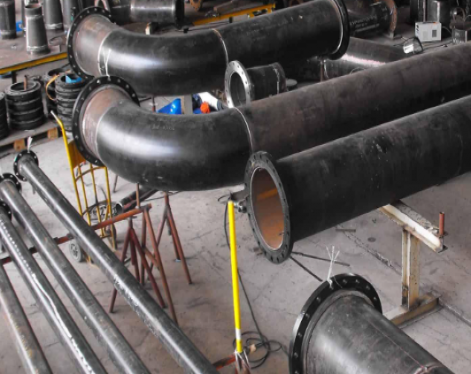
In the field of mechanical engineering, the term 'pipe roughness' is of particular interest, especially when discussing the surface characteristics of various types of pipes such as ERW pipe, and casing pipe.It is one of the problems of interchangeability research. The surface roughness is generally formed by the processing method used and other factors, such as friction between the tool and the part surface during processing, plastic deformation of the surface layer metal when chips are separated, and high-frequency vibration in the process system. Due to the different processing methods and workpiece materials, the depth, density, shape and texture of the marks left on the processed surface are different. Surface roughness is closely related to the matching properties, wear resistance, fatigue strength, contact stiffness, vibration and noise of mechanical parts, and has an important impact on the service life and reliability of mechanical products.
What Is Pipe Roughness: Absolute vs. Relative Roughness
Absolute pipe roughness (ε) is a measure of the irregularity of the walls of commercial pipes. Besides pipes, absolute roughness is also used to indicate the irregularity of the walls of other equipment, such as the walls of heat exchanger shells.
Absolute roughness is expressed in length, typically in millimeters (mm) or feet (ft). For example, the absolute roughness of a smooth aluminum tube is approximately 0.001 mm. In contrast, the absolute roughness value of a concrete surface or a rough concrete tube can exceed 1 mm.
Absolute Roughness
Absolute roughness represents the average height of surface irregularities on the inner wall of a pipe.
Units: length (mm, inches).
Smooth materials (plastic, glass, drawn copper tubing) have very small ε values, while cast iron, concrete, or aged and corroded pipes have significantly higher roughness values.
Relative Roughness (ε/D)
Engineers often use the relative roughness, defined as:
Relative Roughness=D/ε
where D is the pipe’s internal diameter.
Relative roughness is dimensionless and is used together with the Reynolds number to determine the friction factor (f), which directly affects pressure loss.
Pipe absolute roughness
1. What is pipe roughness?
Pipe roughness is the small irregularities on a pipe’s inner surface that create friction during fluid flow.
2. Why does pipe roughness matter?
It affects pressure drop, flow rate, and the energy needed to pump fluids through a pipeline.
3. What materials have low roughness?
PVC, HDPE, copper, and stainless steel plates typically have very low roughness values.
What Is Pipe Roughness: Absolute vs. Relative Roughness
Absolute pipe roughness (ε) is a measure of the irregularity of the walls of commercial pipes. Besides pipes, absolute roughness is also used to indicate the irregularity of the walls of other equipment, such as the walls of heat exchanger shells.Absolute roughness is expressed in length, typically in millimeters (mm) or feet (ft). For example, the absolute roughness of a smooth aluminum tube is approximately 0.001 mm. In contrast, the absolute roughness value of a concrete surface or a rough concrete tube can exceed 1 mm.
Absolute Roughness
Absolute roughness represents the average height of surface irregularities on the inner wall of a pipe.
Units: length (mm, inches).
Smooth materials (plastic, glass, drawn copper tubing) have very small ε values, while cast iron, concrete, or aged and corroded pipes have significantly higher roughness values.
Relative Roughness (ε/D)
Engineers often use the relative roughness, defined as:
Relative Roughness=D/ε
where D is the pipe’s internal diameter.
Relative roughness is dimensionless and is used together with the Reynolds number to determine the friction factor (f), which directly affects pressure loss.
Pipe absolute roughness
| Surface material | Surface material ε mm |
| Aluminum, zinc | 0.001~0.002 |
| Copper, copper tube | 0.0015 |
| PVC plastic tube | 0.0015 |
| Glass fiber | 0.005 |
| Stainless steel | 0.015 |
| Commercial steel pipes | 0.045~0.09 |
| Tensile steel | 0.015 |
| Welded steel | 0.045 |
| Galvanized steel | 0.15 |
| Ordinary steel | 0.15~4 |
| Riveted steel | 0.9~9 |
| New cast iron | 0.25~0.8 |
| Wear cast iron | 0.8~1.5 |
| Corrosion cast iron | 1.5~2.5 |
| Asphalt cast iron | 0.012 |
| Galvanized iron | 0.015 |
| Cement smoothing | 0.3 |
| Ordinary concrete | 0.3~3 |
| Planed wood | 0.18~0.9 |
| Ordinary wood | 5 |
Short FAQ: Pipe Roughness
1. What is pipe roughness?Pipe roughness is the small irregularities on a pipe’s inner surface that create friction during fluid flow.
2. Why does pipe roughness matter?
It affects pressure drop, flow rate, and the energy needed to pump fluids through a pipeline.
3. What materials have low roughness?
PVC, HDPE, copper, and stainless steel plates typically have very low roughness values.