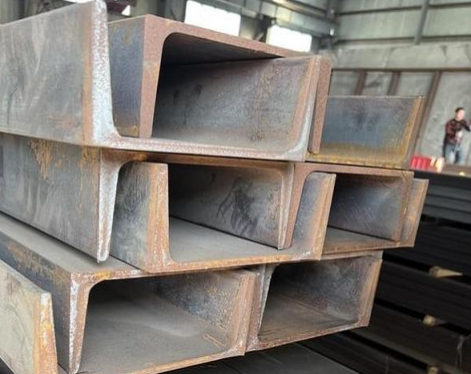
C-channel steel is widely used in construction, infrastructure, and factory equipment manufacturing. This type of steel is lightweight, has a high load-bearing capacity, and is easy to cut and process. C-channel steel manufactured according to the American ASTM standard is a widely used structural profile in North America.
Whether building frames, making equipment supports, or manufacturing trailers and various mechanical equipment, understanding the specifications and dimensions of American standard C-channel steel allows you to select the appropriate material, balancing sturdiness, durability, and cost-effectiveness.
The dimensional tolerances and shape control of American Standard C Channel steel follow ASTM A6/A6M standards. Commonly used material grades include ASTM A36 (yield strength 36 ksi ≈ 250 MPa, most commonly used), A572 Gr.50 (high strength), and A992 (mainstream structural roll-formed profiles), etc.
Surface condition of American structural steel sections:
Conforms to ASTM A6/A6M - 07.
Dimensional requirements:
In accordance with ASTM A6/A6M - 07.
Flange slope:
Approximately 16 2/3%.
American structural steel channels (imperial units):
Standard C channel dimensions are defined in imperial measurements under ASTM specifications.
ASTM A6/A6M
ASTM A484:ASTM A484 covers dimensional requirements for stainless steel channels.
ASTM A1069 :This specification applies to laser-fused stainless steel structural shapes with parallel flanges.
Galvanized Angle Steel vs. Galvanized Channel Steel
Galvanized angle steel has an L-shaped cross-section and is commonly used for corner reinforcement, framing, and light structural bracing where two surfaces meet. In contrast, galvanized channel steel features a C-shaped profile with a web and two flanges, which provides higher stiffness and better load-bearing performance in one direction. Because of this structural difference, angle steel is typically used for lighter support and connection work, while channel steel is preferred for beams, equipment bases, and heavier structural frameworks requiring greater strength and stability.
What does C channel size mean?
A C channel designation identifies the nominal depth and weight per foot. For example, C8 × 11.5 means the channel has an approximate depth of 8 inches and weighs 11.5 pounds per foot.
What is the most common steel channel size?
C6, C8, and C10 channels rank among the most commonly used sizes for structural and fabrication projects.
Is ASTM A36 suitable for steel channels?
Yes. ASTM A36 offers excellent weldability, machinability, and structural performance, making it one of the most widely used channel steel grades.
Whether building frames, making equipment supports, or manufacturing trailers and various mechanical equipment, understanding the specifications and dimensions of American standard C-channel steel allows you to select the appropriate material, balancing sturdiness, durability, and cost-effectiveness.
C Channel Meaning
American Standard C Channel (US C-shaped channel steel/channel section) is an open hot-rolled steel section with a "C"-shaped cross-section—consisting of a vertical web and two flanges. The inner flange has a taper of approximately 1:6 (≈16%), which is the most obvious difference between it and parallel flange steel sections.The dimensional tolerances and shape control of American Standard C Channel steel follow ASTM A6/A6M standards. Commonly used material grades include ASTM A36 (yield strength 36 ksi ≈ 250 MPa, most commonly used), A572 Gr.50 (high strength), and A992 (mainstream structural roll-formed profiles), etc.
Surface condition of American structural steel sections:
Conforms to ASTM A6/A6M - 07.
Dimensional requirements:
In accordance with ASTM A6/A6M - 07.
Flange slope:
Approximately 16 2/3%.
American structural steel channels (imperial units):
Standard C channel dimensions are defined in imperial measurements under ASTM specifications.
ASTM Standards for Steel C Channels
ASTM A36 :ASTM A36 is the most common carbon steel grade for channel sections.ASTM A6/A6M
ASTM A484:ASTM A484 covers dimensional requirements for stainless steel channels.
ASTM A1069 :This specification applies to laser-fused stainless steel structural shapes with parallel flanges.
American Standard C Channel Sizes Chart
The table below summarizes the cross-sectional data for the most common C3 to C15 standard C-channel steels under the ASTM A6/AISC system.| American Standard Steel C Channel Sizes | |||||||||||||
| Desig- | Area, | Depth, | Weight | Flange | Web | Axis X-X | Axis Y-Y | x, | |||||
| nation | A, in2 | d, in | lb/ft | Thickness | in | ||||||||
| Width, | Thickness, | tw, in | I, | S, | r, | I, | S, | r, | |||||
| bf, in | tf, in | in4 | in3 | in | in4 | in3 | in | ||||||
| C15 x 50 | 14.7 | 15 | 50 | 3.716 | 0.65 | 0.716 | 404 | 53.8 | 5.24 | 11 | 3.78 | 0.867 | 0.798 |
| C15 x 40 | 11.8 | 15 | 40 | 3.52 | 0.65 | 0.52 | 349 | 46.5 | 5.44 | 9.23 | 3.37 | 0.886 | 0.777 |
| C15 x 33.9 | 9.96 | 15 | 33.9 | 3.4 | 0.65 | 0.4 | 315 | 42 | 5.62 | 8.13 | 3.11 | 0.904 | 0.787 |
| C12 x 30 | 8.82 | 12 | 30 | 3.17 | 0.501 | 0.51 | 162 | 27 | 4.29 | 5.14 | 2.06 | 0.763 | 0.674 |
| C12 x 25 | 7.35 | 12 | 25 | 3.047 | 0.501 | 0.387 | 144 | 24.1 | 4.43 | 4.47 | 1.88 | 0.78 | 0.674 |
| C12 x 20.7 | 6.09 | 12 | 20.7 | 2.942 | 0.501 | 0.282 | 129 | 21.5 | 4.61 | 3.88 | 1.73 | 0.799 | 0.698 |
| C10 x 30 | 8.82 | 10 | 30 | 3.033 | 0.436 | 0.673 | 103 | 20.7 | 3.42 | 3.94 | 1.65 | 0.669 | 0.649 |
| C10 x 25 | 7.35 | 10 | 25 | 2.886 | 0.436 | 0.526 | 91.2 | 18.2 | 3.52 | 3.36 | 1.48 | 0.676 | 0.617 |
| C10 x 20 | 5.88 | 10 | 20 | 2.739 | 0.436 | 0.379 | 78.9 | 15.8 | 3.66 | 2.81 | 1.32 | 0.692 | 0.606 |
| C10 x 15.3 | 4.49 | 10 | 15.3 | 2.6 | 0.436 | 0.24 | 67.4 | 13.5 | 3.87 | 2.28 | 1.16 | 0.713 | 0.634 |
| C9 x 20 | 5.88 | 9 | 20 | 2.648 | 0.413 | 0.448 | 60.9 | 13.5 | 3.22 | 2.42 | 1.17 | 0.642 | 0.583 |
| C9 x 15 | 4.41 | 9 | 15 | 2.485 | 0.413 | 0.285 | 51 | 11.3 | 3.4 | 1.93 | 1.01 | 0.661 | 0.586 |
| C9 x 13.4 | 3.94 | 9 | 13.4 | 2.433 | 0.413 | 0.233 | 47.9 | 10.6 | 3.48 | 1.76 | 0.962 | 0.669 | 0.601 |
| Desig- | Area, | Depth, | Weight | Flange | Web | Axis X-X | Axis Y-Y | x, | |||||
| nation | A, in2 | d, in | lb/ft | Thickness | in | ||||||||
| Width, | Thickness, | tw, in | I, | S, | r, | I, | S, | r, | |||||
| bf, in | tf, in | in4 | in3 | in | in4 | in3 | in | ||||||
| C8 x 18.75 | 5.51 | 8 | 18.75 | 2.527 | 0.39 | 0.487 | 44 | 11 | 2.82 | 1.98 | 1.01 | 0.599 | 0.565 |
| C8 x 13.75 | 4.04 | 8 | 13.75 | 2.343 | 0.39 | 0.303 | 36.1 | 9.03 | 2.99 | 1.53 | 0.854 | 0.615 | 0.553 |
| C8 x 11.5 | 3.38 | 8 | 11.5 | 2.26 | 0.39 | 0.22 | 32.6 | 8.14 | 3.11 | 1.32 | 0.781 | 0.625 | 0.571 |
| C7 x 14.75 | 4.33 | 7 | 14.75 | 2.299 | 0.366 | 0.419 | 27.2 | 7.78 | 2.51 | 1.38 | 0.779 | 0.564 | 0.532 |
| C7 x 12.25 | 3.6 | 7 | 12.25 | 2.194 | 0.366 | 0.314 | 24.2 | 6.93 | 2.6 | 1.17 | 0.703 | 0.571 | 0.525 |
| C7 x 9.8 | 2.87 | 7 | 9.8 | 2.09 | 0.366 | 0.21 | 21.3 | 6.08 | 2.72 | 0.968 | 0.625 | 0.581 | 0.54 |
| C6 x 13 | 3.83 | 6 | 13 | 2.157 | 0.343 | 0.437 | 17.4 | 5.8 | 2.13 | 1.05 | 0.642 | 0.525 | 0.514 |
| C6 x 10.5 | 3.09 | 6 | 10.5 | 2.034 | 0.343 | 0.314 | 15.2 | 5.06 | 2.22 | 0.866 | 0.564 | 0.529 | 0.499 |
| C6 x 8.2 | 2.4 | 6 | 8.2 | 1.92 | 0.343 | 0.2 | 13.1 | 4.38 | 2.34 | 0.693 | 0.492 | 0.537 | 0.511 |
| C5 x 9 | 2.64 | 5 | 9 | 1.885 | 0.32 | 0.325 | 8.9 | 3.56 | 1.83 | 0.632 | 0.45 | 0.489 | 0.478 |
| C5 x 6.7 | 1.97 | 5 | 6.7 | 1.75 | 0.32 | 0.19 | 7.49 | 3 | 1.95 | 0.479 | 0.378 | 0.493 | 0.484 |
| C4 x 7.25 | 2.13 | 4 | 7.25 | 1.721 | 0.296 | 0.321 | 4.59 | 2.29 | 1.47 | 0.433 | 0.343 | 0.45 | 0.459 |
| C4 x 5.4 | 1.59 | 4 | 5.4 | 1.584 | 0.296 | 0.184 | 3.85 | 1.93 | 1.56 | 0.319 | 0.283 | 0.449 | 0.457 |
| C3 x 6 | 1.76 | 3 | 6 | 1.596 | 0.273 | 0.356 | 2.07 | 1.38 | 1.08 | 0.305 | 0.268 | 0.416 | 0.455 |
| C3 x 5 | 1.47 | 3 | 5 | 1.498 | 0.273 | 0.258 | 1.85 | 1.24 | 1.12 | 0.247 | 0.233 | 0.41 | 0.438 |
| C3 x 4.1 | 1.21 | 3 | 4.1 | 1.41 | 0.273 | 0.17 | 1.66 | 1.1 | 1.17 | 0.197 | 0.202 | 0.404 | 0.436 |
Galvanized Angle Steel vs. Galvanized Channel Steel
Galvanized angle steel has an L-shaped cross-section and is commonly used for corner reinforcement, framing, and light structural bracing where two surfaces meet. In contrast, galvanized channel steel features a C-shaped profile with a web and two flanges, which provides higher stiffness and better load-bearing performance in one direction. Because of this structural difference, angle steel is typically used for lighter support and connection work, while channel steel is preferred for beams, equipment bases, and heavier structural frameworks requiring greater strength and stability.
What does C channel size mean?
A C channel designation identifies the nominal depth and weight per foot. For example, C8 × 11.5 means the channel has an approximate depth of 8 inches and weighs 11.5 pounds per foot.
What is the most common steel channel size?
C6, C8, and C10 channels rank among the most commonly used sizes for structural and fabrication projects.
Is ASTM A36 suitable for steel channels?
Yes. ASTM A36 offers excellent weldability, machinability, and structural performance, making it one of the most widely used channel steel grades.