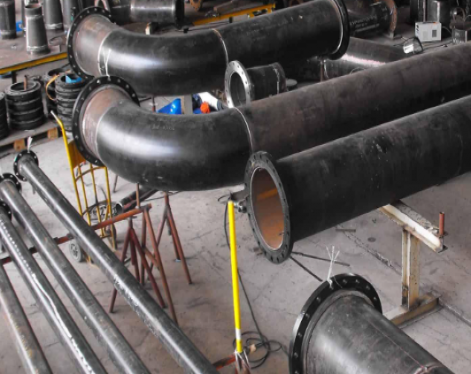
A piping spool is a prefabricated section of a piping system that is assembled in a controlled workshop environment before being installed on-site. By following ASME B31.3 requirements, manufacturers can reduce field welding, improve quality control, and ensure consistent dimensional accuracy.
1. What Are Piping Spool Fabrication ?
ASME B31 piping spool fabrication is the process of manufacturing prefabricated pipe assemblies in accordance with ASME B31 codes, ensuring all components meet strict requirements for safety, strength, and dimensional accuracy. It includes controlled workshop processes such as material selection, welding, inspection, testing, and surface protection to guarantee reliable performance and easy installation on site.A piping spool is a pre-assembled section of piping that typically includes:Pipes (carbon steel, stainless steel, alloy steel)
Flanges
Elbows, tees, reducers
Valves and fittings
Welded joints and supports
Proper fabrication ensures reduced field welding, improved quality control, and faster installation.
2.Fabrication Parameters Under ASME B31.3
In practical engineering applications, piping spool fabrication is defined by several critical parameters. These parameters directly affect installation performance and system reliability.2.1 Dimensional Accuracy (Fit-Up Control)
Dimensional control ensures that piping spools fit correctly during field installation without additional stress or modification.
Key dimensional parameters include:
Center-to-center distance
Face-to-face length
End-to-end alignment
Branch connection positioning
Accurate dimensions reduce installation stress and prevent misalignment.
2.2 Welding Quality
Welding is one of the most critical elements in piping spool fabrication.
ASME B31.3 requires that all welds comply with qualified procedures and certified welders.
Common welding methods include:
GTAW (TIG welding)
SMAW (Stick welding)
SAW (Submerged arc welding)
Welding quality directly affects pressure integrity and fatigue life of the piping system.
2.3Fabrication Tolerances (ASME B31.3 Standard)
Fabrication tolerances define acceptable deviation limits during spool manufacturing.
| Parameter | Allowable Tolerance |
| Center-to-center length | ±3 mm |
| Face-to-face length | ±3 mm |
| End-to-end length | ±3 mm |
| Branch connection location | ±3 mm |
2.4 Weld Alignment Tolerances
| Pipe Size (NPS) | Maximum Misalignment |
| ≤ 24 inches | 1.6 mm |
| ≥ 26 inches | 3.2 mm (if permitted by WPS) |
3.ASME B31 Standards Piping Spool Fabrication Process
Piping spool fabrication is a step-by-step process that starts with material verification and pipe preparation, followed by fit-up, welding, and detailed inspection. After welding quality is confirmed through NDT and pressure testing, the spool is completed with surface treatment such as blasting, coating, and painting to ensure durability and corrosion protection.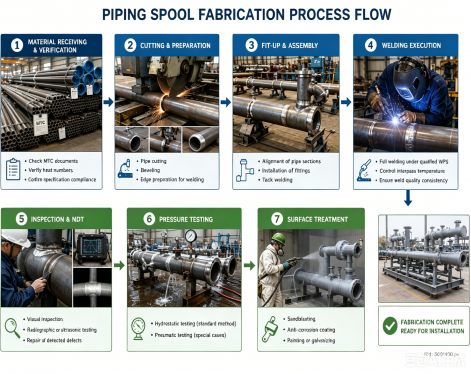
4. Requirements for Piping Spool Fabrication Under ASME B31
4.1 Material Control
Materials must comply with ASTM/ASME standards and remain fully traceable via MTC and heat numbers.
4.2 Fabrication Accuracy
Spools must follow approved drawings and meet required dimensional tolerances.
4.3 Welding & Inspection
Welding must use qualified procedures and certified welders, followed by NDT (VT, RT, UT, etc.).
4.4 Testing & Protection
Hydrostatic testing ensures integrity, and surface treatment is applied for corrosion protection.