EN Standards (European Standards) constitute one of the most significant sets of technical specifications within the global engineering and construction sector. Specifically, the standard for steel angles—EN 10056-1:2017 (Structural steel equal and unequal angles — Part 1: Dimensions)—prescribes the nominal dimensions, tolerance requirements, and marking methods for hot-rolled equal and unequal angles; it is widely applied across various engineering fields, including construction, machinery, and bridge building. Compared to the Chinese National Standard (GB/T 706-2016), the EN Standard exhibits notable differences regarding dimensional precision and material requirements; consequently, understanding its specific characteristics is of paramount importance for material selection in cross-border projects and for facilitating international trade.
The commonly used standard for angle steel is ASTM A36, but this is a standard commonly used in the United States. Today, we'll discuss the dimensions of European standard angle steel.
1.Dimensional Range
Equal-leg angles: The leg width (the length of the two equal legs) ranges from 30 mm to 200 mm (e.g., 30×30 mm, 50×50 mm, 100×100 mm, etc.), while the thickness ranges from 3 mm to 24 mm (e.g., 3 mm, 5 mm, 10 mm, etc.).
Unequal-leg angles: The width of the long leg ranges from 40 mm to 200 mm, and the width of the short leg ranges from 25 mm to 150 mm (e.g., 40×25 mm, 100×75 mm, 150×100 mm, etc.); the thickness similarly ranges from 3 mm to 24 mm.
It should be noted that earlier versions of the EN standard (such as EN 10056-1:1999) featured a smaller dimensional range; the 2017 edition expanded the leg width range up to 200 mm to meet the structural requirements of larger spans.
2.Dimensional Notation Method
The dimensional identification for EN standard angle steel follows the format "Leg Width 1 × Leg Width 2 × Thickness," wherein:
Equal-leg angles: Leg Width 1 = Leg Width 2. For example, L150×150×15 denotes an equal-leg angle with a leg width of 150 mm and a thickness of 15 mm (where "L" is the abbreviation for "Angle");
Unequal-leg angles: Leg Width 1 ≠ Leg Width 2. For example, L100×75×8 denotes an unequal-leg angle with a long leg of 100 mm, a short leg of 75 mm, and a thickness of 8 mm.
This notation method intuitively reflects the cross-sectional characteristics of the angle steel, facilitating rapid specification identification for designers.
3.Dimensional Tolerance Requirements
EN standards impose relatively strict requirements regarding the dimensional tolerances of angle steel. The key parameters are outlined below (based on the 2017 edition):
Leg Width Tolerance: For leg widths ≤ 80 mm, the permissible deviation is ±1.0 mm; for leg widths > 80 mm, the permissible deviation is ±1.5 mm (e.g., for an angle steel with a 100 mm leg width, the actual dimension must fall within the range of 98.5 mm to 101.5 mm).
Thickness Tolerance: For thicknesses ≤ 10 mm, the permissible deviation is ±0.2 mm; for thicknesses > 10 mm, the permissible deviation is ±0.3 mm (e.g., for an angle steel with a thickness of 15 mm, the actual dimension must fall within the range of 14.7 mm to 15.3 mm).
Straightness (Camber): The longitudinal straightness (camber) of the angle steel must not exceed 0.3% of its total length (e.g., for a 6-meter-long angle steel, the camber must not exceed 18 mm).
Perpendicularity: The deviation in the angle between the two legs must not exceed 90° ± 1° (ensuring a tight fit during assembly).
In comparison, the leg width tolerance (±1.5 mm) and thickness tolerance (±0.3 mm) specified in the Chinese National Standard (GB/T 706-2016) are slightly more lenient than those in the EN standards. This is precisely why angle steel manufactured to European standards is renowned in the international market for its "high precision."
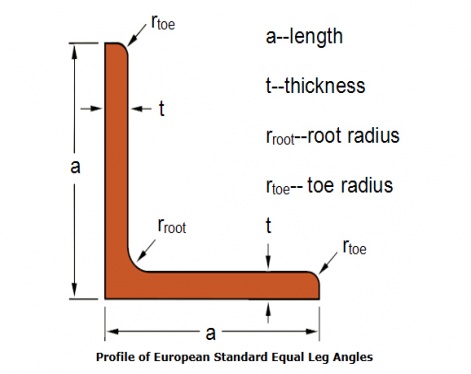
Dimensions of European Standard Equal Leg Angles
Conclusion
With their strict dimensional tolerances, superior material properties, and comprehensive certification systems, EN-standard angle steels have established themselves as a benchmark product within the global engineering and construction sector. As Chinese enterprises engage in cross-border projects—such as overseas engineering initiatives under the "Belt and Road" Initiative—it is crucial to pay close attention to the differences between EN standards and China's national standards (GB). By carefully selecting appropriate materials and specifications, these enterprises can ensure both structural safety and regulatory compliance. Furthermore, driven by the upgrading of China's manufacturing industry, some companies have begun producing "dual-standard angle steels"—products that simultaneously meet both EN and GB standards—thereby offering a wider range of options to the international market.
The commonly used standard for angle steel is ASTM A36, but this is a standard commonly used in the United States. Today, we'll discuss the dimensions of European standard angle steel.
Core Dimensional Specifications for EN Standard Angle Steel
EN 10056-1:2017 is the current valid European standard for structural steel angles. It applies to both hot-rolled equal-leg angles and hot-rolled unequal-leg angles, with the core dimensional requirements outlined as follows:1.Dimensional Range
Equal-leg angles: The leg width (the length of the two equal legs) ranges from 30 mm to 200 mm (e.g., 30×30 mm, 50×50 mm, 100×100 mm, etc.), while the thickness ranges from 3 mm to 24 mm (e.g., 3 mm, 5 mm, 10 mm, etc.).
Unequal-leg angles: The width of the long leg ranges from 40 mm to 200 mm, and the width of the short leg ranges from 25 mm to 150 mm (e.g., 40×25 mm, 100×75 mm, 150×100 mm, etc.); the thickness similarly ranges from 3 mm to 24 mm.
It should be noted that earlier versions of the EN standard (such as EN 10056-1:1999) featured a smaller dimensional range; the 2017 edition expanded the leg width range up to 200 mm to meet the structural requirements of larger spans.
2.Dimensional Notation Method
The dimensional identification for EN standard angle steel follows the format "Leg Width 1 × Leg Width 2 × Thickness," wherein:
Equal-leg angles: Leg Width 1 = Leg Width 2. For example, L150×150×15 denotes an equal-leg angle with a leg width of 150 mm and a thickness of 15 mm (where "L" is the abbreviation for "Angle");
Unequal-leg angles: Leg Width 1 ≠ Leg Width 2. For example, L100×75×8 denotes an unequal-leg angle with a long leg of 100 mm, a short leg of 75 mm, and a thickness of 8 mm.
This notation method intuitively reflects the cross-sectional characteristics of the angle steel, facilitating rapid specification identification for designers.
3.Dimensional Tolerance Requirements
EN standards impose relatively strict requirements regarding the dimensional tolerances of angle steel. The key parameters are outlined below (based on the 2017 edition):
Leg Width Tolerance: For leg widths ≤ 80 mm, the permissible deviation is ±1.0 mm; for leg widths > 80 mm, the permissible deviation is ±1.5 mm (e.g., for an angle steel with a 100 mm leg width, the actual dimension must fall within the range of 98.5 mm to 101.5 mm).
Thickness Tolerance: For thicknesses ≤ 10 mm, the permissible deviation is ±0.2 mm; for thicknesses > 10 mm, the permissible deviation is ±0.3 mm (e.g., for an angle steel with a thickness of 15 mm, the actual dimension must fall within the range of 14.7 mm to 15.3 mm).
Straightness (Camber): The longitudinal straightness (camber) of the angle steel must not exceed 0.3% of its total length (e.g., for a 6-meter-long angle steel, the camber must not exceed 18 mm).
Perpendicularity: The deviation in the angle between the two legs must not exceed 90° ± 1° (ensuring a tight fit during assembly).
In comparison, the leg width tolerance (±1.5 mm) and thickness tolerance (±0.3 mm) specified in the Chinese National Standard (GB/T 706-2016) are slightly more lenient than those in the EN standards. This is precisely why angle steel manufactured to European standards is renowned in the international market for its "high precision."
Dimensions of European Standard Equal Leg Angles
| Designation | Mass | Sectional Area | Dimensions | ||
| kg/m | cm2 | a | t | rroot | |
| mm | mm | mm | |||
| 20×20×3 | 0.882 | 1.12 | 20 | 3 | 3.5 |
| 25×25×3 | 1.12 | 1.42 | 25 | 3 | 3.5 |
| 25×25×4 | 1.45 | 1.85 | 25 | 4 | 3.5 |
| 30×30×3 | 1.36 | 1.74 | 30 | 3 | 5 |
| 30×30×4 | 1.78 | 2.27 | 30 | 4 | 5 |
| 35×35×4 | 2.09 | 2.67 | 35 | 4 | 5 |
| 40×40×4 | 2.42 | 3.08 | 40 | 4 | 6 |
| 40×40×5 | 2.97 | 3.79 | 40 | 5 | 6 |
| 45×45×4.5 | 3.06 | 3.9 | 45 | 4.5 | 7 |
| 50×50×4 | 3.06 | 3.89 | 50 | 4 | 7 |
| 50×50×5 | 3.77 | 4.8 | 50 | 5 | 7 |
| 50×50×6 | 4.47 | 5.69 | 50 | 6 | 7 |
| 60×60×5 | 4.57 | 5.82 | 60 | 5 | 8 |
| 60×60×6 | 5.42 | 6.91 | 60 | 6 | 8 |
| 60×60×8 | 7.09 | 9.03 | 60 | 8 | 8 |
| 65×65×7 | 6.83 | 8.7 | 65 | 7 | 9 |
| 70×70×6 | 6.38 | 8.13 | 70 | 6 | 9 |
| 70×70×7 | 7.38 | 9.4 | 70 | 7 | 9 |
| 75×75×6 | 6.85 | 8.73 | 75 | 6 | 9 |
| 75×75×8 | 8.99 | 11.4 | 75 | 8 | 9 |
| 80×80×8 | 9.63 | 12.3 | 80 | 8 | 10 |
| 80×80×10 | 11.9 | 15.1 | 80 | 10 | 10 |
| 90×90×7 | 9.61 | 12.2 | 90 | 7 | 11 |
| 90×90×8 | 10.9 | 13.9 | 90 | 8 | 11 |
| 90×90×9 | 12.2 | 15.5 | 90 | 9 | 11 |
| 90×90×10 | 13.4 | 17.1 | 90 | 10 | 11 |
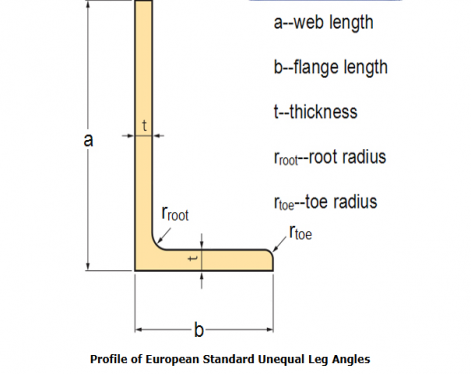
| Designation | Mass | Sectional Area | Dimensions | |||
| kg/m | cm2 | a | b | t | rroot | |
| mm | mm | mm | mm | |||
| 30×20×3 | 1.12 | 1.43 | 30 | 20 | 3 | 4 |
| 30×20×4 | 1.46 | 1.86 | 30 | 20 | 4 | 4 |
| 40×20×4 | 1.77 | 2.26 | 40 | 20 | 4 | 4 |
| 40×25×4 | 1.93 | 2.46 | 40 | 25 | 4 | 4 |
| 45×30×4 | 2.25 | 2.87 | 45 | 30 | 4 | 4.5 |
| 50×30×5 | 2.96 | 3.78 | 50 | 30 | 5 | 5 |
| 60×30×5 | 3.36 | 4.28 | 60 | 30 | 5 | 5 |
| 60×40×5 | 3.76 | 4.79 | 60 | 40 | 5 | 6 |
| 60×40×6 | 4.46 | 5.68 | 60 | 40 | 6 | 6 |
| 65×50×5 | 4.35 | 5.54 | 65 | 50 | 5 | 6 |
| 70×50×6 | 5.41 | 6.89 | 70 | 50 | 6 | 7 |
| 75×50×6 | 5.65 | 7.19 | 75 | 50 | 6 | 7 |
| 75×50×8 | 7.39 | 9.41 | 75 | 50 | 8 | 7 |
| 80×40×6 | 5.41 | 6.89 | 80 | 40 | 6 | 7 |
| 80×40×8 | 7.07 | 9.01 | 80 | 40 | 8 | 7 |
| 100×50×6 | 6.84 | 8.71 | 100 | 50 | 6 | 8 |
| 100×50×8 | 8.97 | 11.4 | 100 | 50 | 8 | 8 |
| 100×65×7 | 8.77 | 11.2 | 100 | 65 | 7 | 10 |
Conclusion
With their strict dimensional tolerances, superior material properties, and comprehensive certification systems, EN-standard angle steels have established themselves as a benchmark product within the global engineering and construction sector. As Chinese enterprises engage in cross-border projects—such as overseas engineering initiatives under the "Belt and Road" Initiative—it is crucial to pay close attention to the differences between EN standards and China's national standards (GB). By carefully selecting appropriate materials and specifications, these enterprises can ensure both structural safety and regulatory compliance. Furthermore, driven by the upgrading of China's manufacturing industry, some companies have begun producing "dual-standard angle steels"—products that simultaneously meet both EN and GB standards—thereby offering a wider range of options to the international market.