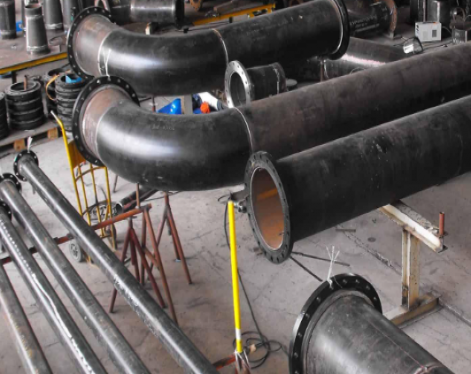
LSAW pipes are a type of steel pipe characterized by a longitudinal weld seam running parallel to the pipe axis. They are generally categorized into thin-walled welded steel pipes, general-purpose welded steel pipes, transformer cooling oil pipes, and similar types. The manufacturing process for straight-seam welded pipes is relatively simple, offering high production efficiency and low costs, which has led to their rapid development. Generally, the strength of spiral-seam welded pipes is higher than that of straight-seam welded pipes. Spiral welding allows for the production of large-diameter pipes using narrow steel strips, or the production of pipes with varying diameters using strips of the same width. However, compared to a straight-seam pipe of the same length, the weld seam length in a spiral pipe is 30% to 100% longer, resulting in a slower production speed. Based on the manufacturing process, straight-seam steel pipes can be classified into High-Frequency (HF) welded straight-seam pipes and Submerged Arc Welded (SAW) straight-seam pipes. Depending on the specific forming method used, Submerged Arc Welded straight-seam pipes can be further categorized into three types: UOE, RBE, and JCOE. The following describes the most common forming processes for LSAW steel pipes.
3. Pre-bending: The plate edges are pre-bent using a pre-bending machine to impart the required curvature to the edges;
4. Forming: On a JCO forming machine, one half of the pre-bent steel plate is pressed into a "J" shape, the other half is then bent into a "C" shape, and finally, an open "O" shape is formed;
5. Pre-welding: The longitudinal seam of the welded steel pipe is continuously welded using Gas Metal Arc Welding (MAG);
6. Internal Welding: The longitudinal seam of the steel pipe is welded using multi-wire longitudinal Submerged Arc Welding (up to 4 wires);
7. External Welding: The exterior of the longitudinal Submerged Arc Welded pipe is welded using multi-wire longitudinal Submerged Arc Welding;
8. Ultrasonic Testing I: A 100% inspection is performed on the internal and external welds, as well as the base metal, of the longitudinal welded pipe;
9. X-ray Inspection I: The internal and external welds undergo 100% inspection using an industrial X-ray TV system equipped with image processing capabilities to ensure high detection sensitivity;
10. Diameter Expansion: The entire length of the longitudinal Submerged Arc Welded pipe is expanded to improve dimensional accuracy and optimize the distribution of internal stresses within the pipe;
11. Hydrostatic Testing: Each expanded steel pipe is individually tested on a hydrostatic testing machine to ensure compliance with standard requirements. The machine features automatic data recording and storage capabilities;
12. Beveling: The ends of the qualified steel pipes are machined to meet the specified requirements for end bevel dimensions;
13. Ultrasonic Testing II: After diameter expansion and hydrostatic testing, the longitudinal welded steel pipes undergo a second ultrasonic inspection to detect any potential defects;
14. X-ray Inspection II: A second inspection using the industrial X-ray TV system is performed, and radiographic films of the pipe end welds are taken following the diameter expansion and hydrostatic testing processes;
15. Pipe End Magnetic Particle Testing: Magnetic Particle Testing is performed on the pipe ends to detect any defects present in those areas;
16. Anti-corrosion Coating: Qualified steel pipes are treated with an anti-corrosion coating in accordance with the user's specific requirements.
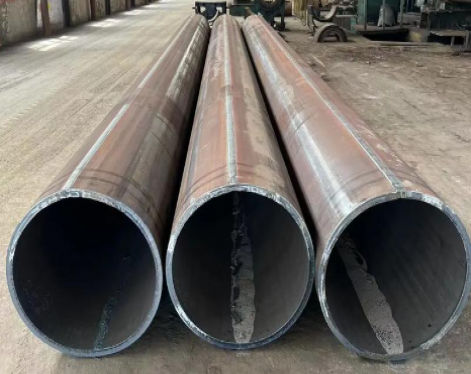
(2) Following a comprehensive mechanical expansion treatment, the steel pipe exhibits low internal stress with a uniform distribution, effectively preventing stress corrosion cracking while ensuring high dimensional accuracy to facilitate on-site welding during construction.
(3) The manufacturing process employs a sequence of pre-welding followed by final welding, resulting in a stable welding process and high-quality weld seams.
(4) The weld seams are readily amenable to non-destructive testing (NDT) during the production phase, as well as to on-site NDT re-inspection during the operational phase.
(5) The product offers a wide range of specifications, enabling the production of steel pipes with both small diameters and heavy wall thicknesses, as well as those with large diameters and heavy wall thicknesses.
LSAW Steel Pipe Forming and Processing Procedure
1. Plate Inspection: Once the steel plate intended for large-diameter submerged arc straight-seam pipes enters the production line, it first undergoes a comprehensive ultrasonic inspection across its entire surface. 2. Edge Milling: The edges on both sides of the steel plate are milled using an edge milling machine to meet requirements regarding plate width, edge parallelism, and bevel profile;3. Pre-bending: The plate edges are pre-bent using a pre-bending machine to impart the required curvature to the edges;
4. Forming: On a JCO forming machine, one half of the pre-bent steel plate is pressed into a "J" shape, the other half is then bent into a "C" shape, and finally, an open "O" shape is formed;
5. Pre-welding: The longitudinal seam of the welded steel pipe is continuously welded using Gas Metal Arc Welding (MAG);
6. Internal Welding: The longitudinal seam of the steel pipe is welded using multi-wire longitudinal Submerged Arc Welding (up to 4 wires);
7. External Welding: The exterior of the longitudinal Submerged Arc Welded pipe is welded using multi-wire longitudinal Submerged Arc Welding;
8. Ultrasonic Testing I: A 100% inspection is performed on the internal and external welds, as well as the base metal, of the longitudinal welded pipe;
9. X-ray Inspection I: The internal and external welds undergo 100% inspection using an industrial X-ray TV system equipped with image processing capabilities to ensure high detection sensitivity;
10. Diameter Expansion: The entire length of the longitudinal Submerged Arc Welded pipe is expanded to improve dimensional accuracy and optimize the distribution of internal stresses within the pipe;
11. Hydrostatic Testing: Each expanded steel pipe is individually tested on a hydrostatic testing machine to ensure compliance with standard requirements. The machine features automatic data recording and storage capabilities;
12. Beveling: The ends of the qualified steel pipes are machined to meet the specified requirements for end bevel dimensions;
13. Ultrasonic Testing II: After diameter expansion and hydrostatic testing, the longitudinal welded steel pipes undergo a second ultrasonic inspection to detect any potential defects;
14. X-ray Inspection II: A second inspection using the industrial X-ray TV system is performed, and radiographic films of the pipe end welds are taken following the diameter expansion and hydrostatic testing processes;
15. Pipe End Magnetic Particle Testing: Magnetic Particle Testing is performed on the pipe ends to detect any defects present in those areas;
16. Anti-corrosion Coating: Qualified steel pipes are treated with an anti-corrosion coating in accordance with the user's specific requirements.
Key Processing Characteristics of LSAW Steel Pipes:
(1) The steel pipe features a single longitudinal weld seam; both the inner and outer seams are welded using a single pass of submerged arc welding.(2) Following a comprehensive mechanical expansion treatment, the steel pipe exhibits low internal stress with a uniform distribution, effectively preventing stress corrosion cracking while ensuring high dimensional accuracy to facilitate on-site welding during construction.
(3) The manufacturing process employs a sequence of pre-welding followed by final welding, resulting in a stable welding process and high-quality weld seams.
(4) The weld seams are readily amenable to non-destructive testing (NDT) during the production phase, as well as to on-site NDT re-inspection during the operational phase.
(5) The product offers a wide range of specifications, enabling the production of steel pipes with both small diameters and heavy wall thicknesses, as well as those with large diameters and heavy wall thicknesses.