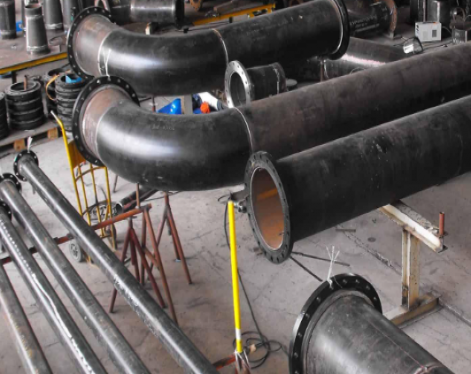
What Is a Seamless Pipe?
A seamless pipe is manufactured from a solid steel billet that is heated and pierced to form a hollow tube without any welded seams. Unlike welded pipes, a seamless pipe has a continuous metal structure, providing more uniform strength and stress distribution throughout the pipe wall.
Key characteristics of seamless pipe include:
No weld seam
Uniform mechanical properties
Higher pressure resistance
Better fatigue performance
Excellent reliability in critical applications
Because of these advantages, seamless pipes are widely used in oil and gas, petrochemical, power generation, and other industries where high pressure, high temperature, and long-term reliability are critical.
1.High-Pressure Applications
Pressure is often the first factor that drives pipe selection.
As internal pressure increases, hoop stress rises proportionally.
Because seamless pipes eliminate weld-related discontinuities, they generally provide more predictable pressure performance.
Typical applications include:
Oil and gas transmission
High-pressure natural gas systems
Refinery process piping
Hydraulic equipment
High-pressure steam lines
2.General Pressure Selection Guideline
Actual pressure ratings should always be verified according to ASME B31.3, ASME B31.1, API standards, or project specifications.
3.Systems Subjected to Fatigue Loading
Many industrial pipelines experience continuous pressure fluctuations.
Examples include:
Compressor discharge lines
Hydraulic systems
Offshore production facilities
Process units with frequent start-stop cycles
Under these conditions, fatigue behavior becomes more important than static strength.
Over time, stress concentrations around weld zones can accumulate damage.
Seamless pipe minimizes this concern by providing a continuous structure without weld-related stress concentration points.
4.High-Temperature Service
Temperature introduces a different engineering challenge.
At elevated temperatures, material performance depends not only on strength but also on long-term microstructural stability.
Heat-affected zones around welds are generally more sensitive to:
Creep deformation
Thermal fatigue
Metallurgical changes
For this reason, seamless pipe is commonly specified in:
Boilers
Steam pipelines
Power plants
Heat exchangers
Refinery units
ASTM A106 seamless pipe remains one of the most widely used materials for these services.
5.Corrosive and Sour Service Environments
Corrosion can significantly shorten pipeline life.
Industries handling aggressive media often prefer seamless pipe because it reduces potential defect locations.
Common environments include:
H₂S service
CO₂ service
Seawater systems
Chemical processing
Offshore facilities
Material selection should also consider corrosion-resistant alloys, coatings, and project-specific standards.
Key characteristics of seamless pipe include:
No weld seam
Uniform mechanical properties
Higher pressure resistance
Better fatigue performance
Excellent reliability in critical applications
Because of these advantages, seamless pipes are widely used in oil and gas, petrochemical, power generation, and other industries where high pressure, high temperature, and long-term reliability are critical.
When Should You Choose Seamless Pipe?
Choose seamless pipe when high strength, high pressure resistance, and reliability are required. Since it has no welded seam, it offers a more uniform structure and better performance in demanding applications such as oil and gas, power plants, and high-temperature systems.1.High-Pressure Applications
Pressure is often the first factor that drives pipe selection.
As internal pressure increases, hoop stress rises proportionally.
Because seamless pipes eliminate weld-related discontinuities, they generally provide more predictable pressure performance.
Typical applications include:
Oil and gas transmission
High-pressure natural gas systems
Refinery process piping
Hydraulic equipment
High-pressure steam lines
2.General Pressure Selection Guideline
| Design Pressure | Recommended Pipe Type |
| Below 5 MPa | Welded Pipe |
| 5–10 MPa | ERW or Seamless |
| Above 10 MPa | Seamless Preferred |
| Above 20 MPa | Seamless Strongly Recommended |
3.Systems Subjected to Fatigue Loading
Many industrial pipelines experience continuous pressure fluctuations.
Examples include:
Compressor discharge lines
Hydraulic systems
Offshore production facilities
Process units with frequent start-stop cycles
Under these conditions, fatigue behavior becomes more important than static strength.
Over time, stress concentrations around weld zones can accumulate damage.
Seamless pipe minimizes this concern by providing a continuous structure without weld-related stress concentration points.
4.High-Temperature Service
Temperature introduces a different engineering challenge.
At elevated temperatures, material performance depends not only on strength but also on long-term microstructural stability.
Heat-affected zones around welds are generally more sensitive to:
Creep deformation
Thermal fatigue
Metallurgical changes
For this reason, seamless pipe is commonly specified in:
Boilers
Steam pipelines
Power plants
Heat exchangers
Refinery units
ASTM A106 seamless pipe remains one of the most widely used materials for these services.
5.Corrosive and Sour Service Environments
Corrosion can significantly shorten pipeline life.
Industries handling aggressive media often prefer seamless pipe because it reduces potential defect locations.
Common environments include:
H₂S service
CO₂ service
Seawater systems
Chemical processing
Offshore facilities
Material selection should also consider corrosion-resistant alloys, coatings, and project-specific standards.
Industry Standards for Seamless Pipes
Seamless pipes are produced according to international standards to ensure consistent quality and performance. Some of the most recognized standards include:
API 5L – For line pipe used in oil and gas transportation
ASTM A106 / A53 – For high-temperature and general-purpose carbon steel pipes
ASTM A333 – For low-temperature service applications
ASTM A312 – For stainless steel seamless pipes
EN 10216 – European standard for pressure applications
These standards specify mechanical properties, chemical composition, testing requirements, and dimensional tolerances, ensuring that seamless pipes meet the highest performance demands.
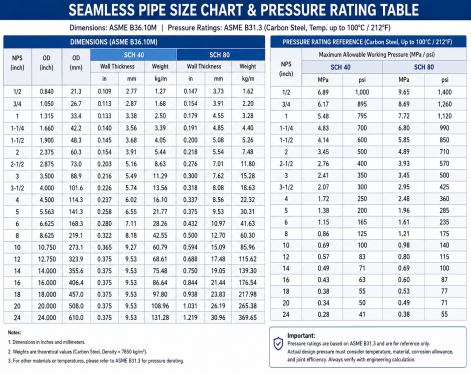
Including this chart helps engineers quickly compare dimensions, wall thicknesses, and approximate pressure capabilities during preliminary design.
At what pressure should seamless pipe be used?
There is no universal pressure limit because allowable pressure depends on:
Pipe diameter
Wall thickness
Material grade
Design temperature
Applicable code requirements
However, the following guideline is commonly used.
Actual pressure calculations should always follow ASME B31.3, ASME B31.1, API standards, or project-specific design codes.
Common HS codes for seamless carbon steel pipes include 730431 for cold-drawn seamless pipes and 730439 for other seamless steel pipes. The final HS code depends on the manufacturing process and pipe specification.
Different applications may require different standards. ASTM, API, and EN are commonly requested for industrial, oil and gas, and pipeline projects. Suppliers usually provide documents such as MTRs, mill certificates, inspection reports, and certificates of origin to support quality verification and customs clearance.
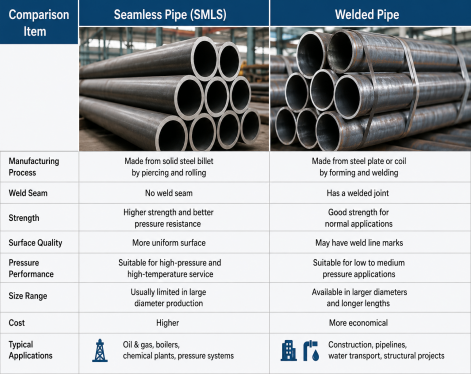
In short, seamless pipes are preferred for critical applications requiring high strength and reliability, while welded pipes are a cost-effective choice for general industrial and structural uses.
However, seamless pipe is not always necessary. Modern welded pipes provide excellent performance for many industrial and structural applications at a lower cost.The best pipe selection should always be based on operating pressure, temperature, service environment, industry standards, and project economics rather than on manufacturing method alone.
Generally, yes. Seamless pipe provides more uniform strength and better resistance to pressure and fatigue loading.
What pressure requires seamless pipe?
Many engineers prefer seamless pipe for systems above 10 MPa, although actual selection depends on design codes and operating conditions.
Is Schedule 80 seamless pipe stronger than Schedule 40?
Yes. Schedule 80 pipe has a thicker wall and therefore can withstand higher internal pressure.
Why is seamless pipe used in refineries?
Refineries operate under high pressure and high temperature. Seamless pipe offers greater reliability and minimizes the risk of weld-related failures.
API 5L – For line pipe used in oil and gas transportation
ASTM A106 / A53 – For high-temperature and general-purpose carbon steel pipes
ASTM A333 – For low-temperature service applications
ASTM A312 – For stainless steel seamless pipes
EN 10216 – European standard for pressure applications
These standards specify mechanical properties, chemical composition, testing requirements, and dimensional tolerances, ensuring that seamless pipes meet the highest performance demands.
Seamless Pipe Size and Pressure Rating Reference Chart
The following chart provides a useful reference for common seamless pipe sizes and SCH ratings.Including this chart helps engineers quickly compare dimensions, wall thicknesses, and approximate pressure capabilities during preliminary design.
Pressure Rating Considerations for Seamless Pipe
One of the most common questions is:At what pressure should seamless pipe be used?
There is no universal pressure limit because allowable pressure depends on:
Pipe diameter
Wall thickness
Material grade
Design temperature
Applicable code requirements
However, the following guideline is commonly used.
| Service Pressure | Recommended Pipe Type |
| Below 5 MPa | Welded Pipe |
| 5–10 MPa | ERW or Seamless |
| Above 10 MPa | Seamless Preferred |
| Above 20 MPa | Seamless Strongly Recommended |
Actual pressure calculations should always follow ASME B31.3, ASME B31.1, API standards, or project-specific design codes.
SMLS Pipe Export Requirements, HS Codes, and Certifications
For international SMLS pipe projects, buyers need to check not only pipe dimensions and grades but also export documents, standards, and certification requirements.Common HS codes for seamless carbon steel pipes include 730431 for cold-drawn seamless pipes and 730439 for other seamless steel pipes. The final HS code depends on the manufacturing process and pipe specification.
Different applications may require different standards. ASTM, API, and EN are commonly requested for industrial, oil and gas, and pipeline projects. Suppliers usually provide documents such as MTRs, mill certificates, inspection reports, and certificates of origin to support quality verification and customs clearance.
| Item | Requirement |
| HS Code | 730431 / 730439 |
| Standards | ASTM, API, EN |
| Documents | MTR, Mill Certificate, Inspection Report |
| Inspection | Third-party inspection if required |
| Focus | Certification and traceability |
Seamless vs Welded Pipe
The choice between seamless and welded pipes depends on operating conditions, not just manufacturing methods. Welded pipes meet most needs, including water systems, structures, and general pipelines. However, seamless pipes become preferable when higher strength, pressure resistance, and reliability are required.In short, seamless pipes are preferred for critical applications requiring high strength and reliability, while welded pipes are a cost-effective choice for general industrial and structural uses.
Conclusion
Seamless pipe is the preferred solution for high-pressure, high-temperature, and safety-critical applications. Its continuous structure, superior fatigue resistance, and reliable long-term performance make it indispensable in industries such as oil and gas, petrochemical processing, power generation, and heavy engineering.However, seamless pipe is not always necessary. Modern welded pipes provide excellent performance for many industrial and structural applications at a lower cost.The best pipe selection should always be based on operating pressure, temperature, service environment, industry standards, and project economics rather than on manufacturing method alone.
Frequently Asked Questions
Is seamless pipe stronger than welded pipe?Generally, yes. Seamless pipe provides more uniform strength and better resistance to pressure and fatigue loading.
What pressure requires seamless pipe?
Many engineers prefer seamless pipe for systems above 10 MPa, although actual selection depends on design codes and operating conditions.
Is Schedule 80 seamless pipe stronger than Schedule 40?
Yes. Schedule 80 pipe has a thicker wall and therefore can withstand higher internal pressure.
Why is seamless pipe used in refineries?
Refineries operate under high pressure and high temperature. Seamless pipe offers greater reliability and minimizes the risk of weld-related failures.