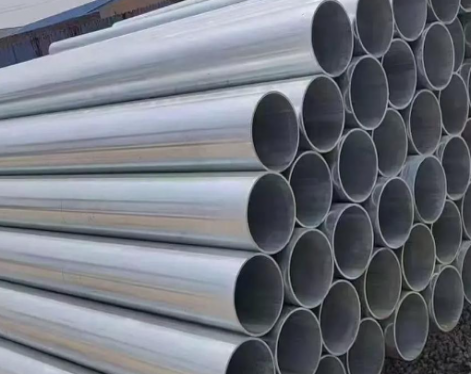
ERW steel pipes are widely used in construction, water systems, scaffolding, and structural projects. One of the key reasons for their popularity is that ERW steel pipes are highly suitable for galvanizing, especially hot-dip galvanizing. Galvanizing significantly improves corrosion resistance and extends the service life of steel pipes, making them more reliable in both indoor and outdoor environments. Below is a comprehensive explanation based on common industry standards and best practices found in leading technical resources.
1. Highly controllable weld quality: During ERW welding, the skin effect of the high-frequency current concentrates heat at the edge of the steel plate. Combined with precise pressure control of the extrusion rollers, a continuous and uniform weld structure can be formed. Compared to traditional spiral welded pipes or seamless steel pipes, ERW welds have a higher degree of grain refinement and less impurity segregation, providing a uniform substrate surface for subsequent galvanizing.
2. Moderate surface roughness: After forming, ERW steel pipes undergo online heat treatment, resulting in a loose and easily peelable oxide scale. Actual measurement data shows that the surface roughness Ra value of high-quality ERW steel pipes is typically in the range of 12-25μm, preserving sufficient microscopic anchor points to enhance coating adhesion while avoiding uneven coating thickness caused by excessive roughness.
3. Excellent Dimensional Accuracy: The continuous rolling process ensures that the outer diameter tolerance of the ERW steel pipe is controlled within ±0.5%, and the wall thickness deviation does not exceed ±10%. This high-precision characteristic ensures sufficient and uniform wetting of the galvanizing bath, avoiding localized missed or over-plating.
One of the most important factors for successful galvanizing is the condition of the pipe surface. ERW pipes are produced from high-quality steel coils that undergo controlled forming and welding processes. This results in a relatively smooth and uniform outer surface.
A clean and even surface allows the zinc coating to adhere properly during the galvanizing process, forming a strong metallurgical bond between the zinc layer and the steel substrate. This ensures consistent coating thickness and long-term corrosion protection.
2. Stable Manufacturing Process
The ERW manufacturing process is highly automated and standardized. Pipes produced through this method typically meet international standards such as:
ASTM A53
ASTM A500
EN 10219
API 5L (some applications)
Because the production quality is stable and predictable, ERW pipes perform well during the pickling, cleaning, fluxing, and hot-dip galvanizing stages. This stability helps manufacturers achieve uniform zinc coating quality across large production batches, which is essential for infrastructure and construction projects.
3. Excellent Compatibility With Hot-Dip Galvanizing
Hot-dip galvanizing involves immersing steel pipes into molten zinc at high temperatures. ERW pipes respond well to this process because:
The steel composition is suitable for zinc bonding
The weld seam can be treated and cleaned before coating
The pipe geometry allows full zinc coverage inside and outside
As a result, galvanized ERW pipes often show strong corrosion resistance and durable protective layers, even in harsh environments such as humid, industrial, or outdoor conditions.
Product Chemical Composition & Mechanical Properties
The technological characteristics of ERW steel pipes lay the foundation for galvanizing
ERW (Electric Resistance Welding) steel pipes utilize resistance heating generated by high-frequency current to achieve edge fusion of the steel plate. This manufacturing process determines unique microstructural characteristics:1. Highly controllable weld quality: During ERW welding, the skin effect of the high-frequency current concentrates heat at the edge of the steel plate. Combined with precise pressure control of the extrusion rollers, a continuous and uniform weld structure can be formed. Compared to traditional spiral welded pipes or seamless steel pipes, ERW welds have a higher degree of grain refinement and less impurity segregation, providing a uniform substrate surface for subsequent galvanizing.
2. Moderate surface roughness: After forming, ERW steel pipes undergo online heat treatment, resulting in a loose and easily peelable oxide scale. Actual measurement data shows that the surface roughness Ra value of high-quality ERW steel pipes is typically in the range of 12-25μm, preserving sufficient microscopic anchor points to enhance coating adhesion while avoiding uneven coating thickness caused by excessive roughness.
3. Excellent Dimensional Accuracy: The continuous rolling process ensures that the outer diameter tolerance of the ERW steel pipe is controlled within ±0.5%, and the wall thickness deviation does not exceed ±10%. This high-precision characteristic ensures sufficient and uniform wetting of the galvanizing bath, avoiding localized missed or over-plating.
Why ERW Steel Pipes Are Suitable for Galvanizing
1. Smooth and Uniform Surface QualityOne of the most important factors for successful galvanizing is the condition of the pipe surface. ERW pipes are produced from high-quality steel coils that undergo controlled forming and welding processes. This results in a relatively smooth and uniform outer surface.
A clean and even surface allows the zinc coating to adhere properly during the galvanizing process, forming a strong metallurgical bond between the zinc layer and the steel substrate. This ensures consistent coating thickness and long-term corrosion protection.
2. Stable Manufacturing Process
The ERW manufacturing process is highly automated and standardized. Pipes produced through this method typically meet international standards such as:
ASTM A53
ASTM A500
EN 10219
API 5L (some applications)
Because the production quality is stable and predictable, ERW pipes perform well during the pickling, cleaning, fluxing, and hot-dip galvanizing stages. This stability helps manufacturers achieve uniform zinc coating quality across large production batches, which is essential for infrastructure and construction projects.
3. Excellent Compatibility With Hot-Dip Galvanizing
Hot-dip galvanizing involves immersing steel pipes into molten zinc at high temperatures. ERW pipes respond well to this process because:
The steel composition is suitable for zinc bonding
The weld seam can be treated and cleaned before coating
The pipe geometry allows full zinc coverage inside and outside
As a result, galvanized ERW pipes often show strong corrosion resistance and durable protective layers, even in harsh environments such as humid, industrial, or outdoor conditions.
Product Chemical Composition & Mechanical Properties
| Grade | Chemical Composition | Mechanical Properties | ||||||
| C | Mn | Si | S | P | Yield | Tensile | Elonga | |
| strength | Strength | -tion | ||||||
| MPa | Mpa | % | ||||||
| Q195 | 0.06 | 0.25 | ≤0.30 | ≤0.045 | ≤0.05 | 195 | 315-430 | 33 |
| -0.12 | -0.5 | |||||||
| Q235 | 0.12- | 0.3 | ≤0.30 | ≤0.045 | ≤0.04 | 235 | 375-500 | 26 |
| 0.2 | -0.67 | |||||||
| Q345 | ≤0.20 | 1 | ≤0.55 | ≤0.04 | ≤0.04 | 345 | 475-630 | 22 |
| -1.6 | ||||||||