EN 10220 is a European standard that defines the dimensions and masses of seamless and welded steel pipes used in various industrial applications. Unlike manufacturing standards that regulate chemical composition or mechanical properties, EN 10220 focuses specifically on pipe size, outside diameter (OD), wall thickness, and weight per meter.
This standard is widely used across Europe, the Middle East, Asia, and global engineering projects to ensure consistency when specifying pipes for structural, mechanical, and pressure applications.
EN 10220 works together with several other European pipe standards, such as:
EN 10216 – Seamless steel tubes for pressure purposes
EN 10217 – Welded steel tubes for pressure purposes
EN 10219 – Cold-formed welded structural hollow sections
EN 10210 – Hot-finished structural hollow sections
By defining uniform pipe dimensions, EN 10220 ensures compatibility between different manufacturers and international engineering specifications.
Outside diameter (OD)
Wall thickness
Theoretical weight per meter
Preferred pipe size series
The standard applies to both:
Seamless steel pipes
Welded steel pipes
It is primarily used in industries such as:
Oil and gas transportation
Construction and structural engineering
Mechanical manufacturing
Power plants and boilers
Chemical processing systems
Because EN 10220 defines the dimension system, it is often used alongside material standards that specify steel grades.
2. Theoretical Weight Calculation Method: The standard provides a unified formula for calculating the theoretical weight of steel pipes based on dimensions (outer diameter, wall thickness) and material density (generally 7.85 kg/dm³).
3. Size and Wall Thickness Tolerance Table: This standard provides the permissible deviations for outside diameter, wall thickness, and ovality for steel pipes of different manufacturing processes (seamless, welded) and size ranges.
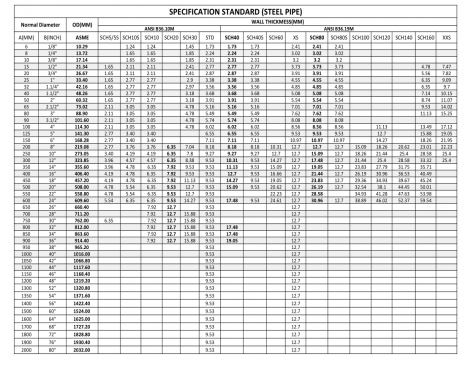
4. EN 10220 Steel Tube Dimension Reference Tables: These tables contain a range of commonly used steel tube dimensions and their corresponding theoretical weights. However, these tables are for illustrative purposes only and are not intended to be strict product specifications, as in EN 10210-2 or EN 10219-2.
1. Manufacturing Process
Seamless pipes are made by piercing and rolling solid steel billets into hollow tubes, so they have no welded seam. Welded pipes are produced by forming steel plates or coils into a tube and welding the joint.
2. Structure
Seamless pipes have a uniform structure without a weld seam, while welded pipes contain a longitudinal or spiral seam created during welding.
3. Performance
Seamless pipes generally provide higher pressure and temperature resistance. Welded pipes offer reliable strength for general industrial and structural use.
4. Size Range
Seamless pipes are usually produced in small to medium diameters, while welded pipes can be manufactured in much larger diameters.
5. Applications
Seamless pipes are commonly used in oil and gas drilling, boilers, and power plants. Welded pipes are widely used in water pipelines, construction structures, and infrastructure projects.
This standard is widely used across Europe, the Middle East, Asia, and global engineering projects to ensure consistency when specifying pipes for structural, mechanical, and pressure applications.
EN 10220 works together with several other European pipe standards, such as:
EN 10216 – Seamless steel tubes for pressure purposes
EN 10217 – Welded steel tubes for pressure purposes
EN 10219 – Cold-formed welded structural hollow sections
EN 10210 – Hot-finished structural hollow sections
By defining uniform pipe dimensions, EN 10220 ensures compatibility between different manufacturers and international engineering specifications.
What Is EN 10220?
EN 10220 is a European specification that standardizes:Outside diameter (OD)
Wall thickness
Theoretical weight per meter
Preferred pipe size series
The standard applies to both:
Seamless steel pipes
Welded steel pipes
It is primarily used in industries such as:
Oil and gas transportation
Construction and structural engineering
Mechanical manufacturing
Power plants and boilers
Chemical processing systems
Because EN 10220 defines the dimension system, it is often used alongside material standards that specify steel grades.
EN 10220 Pipe Dimension System
Basic Contents of the EN 10220 Standard:
1. Size Series Definition: This standard defines size series based on outside diameter, which is crucial when selecting pipes and fittings.2. Theoretical Weight Calculation Method: The standard provides a unified formula for calculating the theoretical weight of steel pipes based on dimensions (outer diameter, wall thickness) and material density (generally 7.85 kg/dm³).
3. Size and Wall Thickness Tolerance Table: This standard provides the permissible deviations for outside diameter, wall thickness, and ovality for steel pipes of different manufacturing processes (seamless, welded) and size ranges.
4. EN 10220 Steel Tube Dimension Reference Tables: These tables contain a range of commonly used steel tube dimensions and their corresponding theoretical weights. However, these tables are for illustrative purposes only and are not intended to be strict product specifications, as in EN 10210-2 or EN 10219-2.
Seamless vs Welded Pipes Under EN 10220
The European standard EN 10220 defines the dimensions and theoretical mass of steel pipes, covering both seamless and welded types. Although they share the same dimensional system, their production methods and applications differ.1. Manufacturing Process
Seamless pipes are made by piercing and rolling solid steel billets into hollow tubes, so they have no welded seam. Welded pipes are produced by forming steel plates or coils into a tube and welding the joint.
2. Structure
Seamless pipes have a uniform structure without a weld seam, while welded pipes contain a longitudinal or spiral seam created during welding.
3. Performance
Seamless pipes generally provide higher pressure and temperature resistance. Welded pipes offer reliable strength for general industrial and structural use.
4. Size Range
Seamless pipes are usually produced in small to medium diameters, while welded pipes can be manufactured in much larger diameters.
5. Applications
Seamless pipes are commonly used in oil and gas drilling, boilers, and power plants. Welded pipes are widely used in water pipelines, construction structures, and infrastructure projects.